
V@RR Shipping Transition Series
Supporting the Thesis:
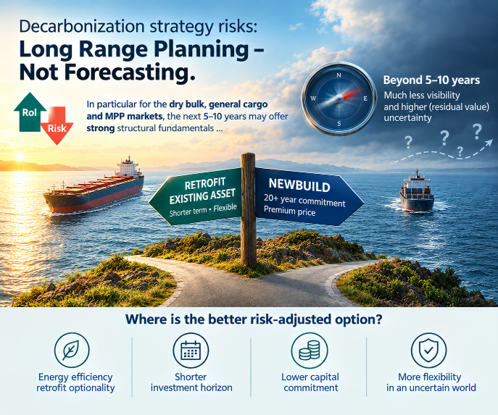
Decarbonization strategy risks – Long-Range Planning, Not Forecasting
“Long-range planning is necessary precisely because we cannot forecast.”
Peter Drucker
Shipping has always been a cyclical industry, and predicting its cycles has proved notoriously difficult. Even when the fundamental supply/demand equation appears clear, freight markets are influenced by numerous variables: economic growth, commodity demand, fleet development, shipyard capacity, trade patterns, regulation, geopolitical events and changes in vessel productivity.
This is why we at V@RR always say that predicting expected event scenario’s is difficult and therefore understanding the impact of unexpected events using historic benchmarking and placing them in perspective is crucial for resilient shipping investments.
Today, however, the challenge is becoming even greater. The shipping industry is at the start of a period in which several major transitions are taking place simultaneously. Rather than dealing with one dominant change, shipowners, investors and financiers are required to make long-term decisions against a backdrop of multiple interconnected uncertainties.
At V@RR, we see six major transitions shaping the coming decade:
1. Regulatory transition
2. Energy and commodity transition
3. Technological and infrastructure transition
4. Geopolitical transition
5. Data and information transition
6. Manufacturing and logistics transition
Together, these developments create a level of uncertainty that traditional shipping-cycle analysis may not fully capture.
The Real Uncertainty: It Is Not Just About Fuel
Much of today’s shipping discussion focuses on the question of which future fuel or propulsion technology will ultimately prevail. This is clearly important—but it is only part of the picture.
For shipping stakeholders, the next decade also raises fundamental questions around:
● Which fuels will actually become available, and where?
● How quickly will the required infrastructure develop?
● How will carbon regulation and carbon economics evolve?
● Will world trade remain increasingly global, or become more regional?
● Which commodities and products will move, and on which trade routes?
● How will changing trade patterns/commodity demand affect vessel design?
● How will these developments influence capital availability, asset values and freight rates?
These questions are closely interconnected. A different energy system will influence commodity flows. Changing manufacturing locations may reshape trade patterns. Geopolitical developments may accelerate regionalization and supply-chain diversification. New trade patterns may require different vessel designs, sizes and operational flexibility. The result is that the next 5–10 years are likely to be a period of transition rather than one of clarity.
This makes long-range planning increasingly important—but also makes long-range forecasting increasingly unreliable. The primary challenge facing shipping is not identifying the winning fuel. The primary challenge is allocating capital effectively during a prolonged period of technological, regulatory, infrastructural and geopolitical uncertainty.
A Different Shipping Cycle?
At V@RR, we believe there are good reasons to consider whether the next shipping cycle could differ materially from the historic patterns often used as benchmarks.
The exceptional markets of 2004–2008 and 2021–2025 are unlikely to represent sustainable long-term benchmarks. Both periods were driven by exceptional circumstances and significant supply/demand imbalances. At the same time, the relatively weak average market environment of 2010–2020 may also prove to be an unreliable benchmark for the coming decade.
The question should therefore not simply be: Will freight rates remain high?Our idea is that this may be more nuanced: “Could the structural floor under effective vessel demand remain stronger than traditional shipping-cycle analysis suggests?”
For several sectors, the answer may increasingly be yes.
This is particularly relevant for markets characterized by some combination of:
● An ageing fleet;
● A relatively limited newbuilding orderbook;
● Significant replacement requirements;
● Increasing technical and regulatory pressure on older vessels;
● Limited shipyard capacity;
● And relatively low impact of temporary geopolitical driven ton-mile increases (ME/Ukraine) on current rates
Dry bulk, general cargo/short sea and MPP are particularly interesting in this respect. Crude and product tankers may also share some of these characteristics, although their supply/demand dynamics differ. An ageing fleet combined with limited replacement capacity creates a fundamentally different starting point from the oversupply conditions that characterized significant parts of the previous cycle.
At the same time, the energy transition and changing regulatory environment may accelerate the economic obsolescence of parts of the existing fleet—while uncertainty about future technology may discourage some owners from committing to newbuildings.
This combination could provide stronger structural support to vessel demand and asset utilization than historic averages might suggest. That does not mean that freight rates will remain permanently high. Shipping will remain cyclical. But it may mean that the lows of the next cycle are higher than those implied by a simple comparison with the 2010–2020 period.
Investment Horizon May Matter More Than Asset Price
This brings us to an important investment question. If we have reasonable conviction about the fundamentals for the next 5–10 years, but significantly less visibility beyond that period, how should capital be deployed?
For a diversified shipping company, the answer may include newbuilding’s. Newbuilding’s provide access to the next generation of vessels and technology. They offer exposure to the post-transition market and allow diversified owners to spread technological and market risk across a portfolio of assets and investment vintages.
For a single-asset investor or financier, however, the situation may be fundamentally different. A newbuilding purchased today at historically high prices can represent an investment commitment extending well beyond twenty years. Including the period between investment decision and delivery, the investor is effectively making a long-term bet on:
● Future technology;
● Future fuel availability;
● Regulation;
● Trade patterns;
● Vessel design;
● Freight markets;
● Asset values;
● And ultimately the economic relevance of the vessel throughout its operating life.
That is a very long investment horizon of more than 25 years during a period in which the industry itself is undergoing fundamental transition. The question is therefore not simply whether a second-hand vessel is cheaper than a newbuilding. The more important question may be whether the duration of the investment is aligned with the duration of the period of reasonable visibility the investors/financiers have – and same time provides an option to explore longer term developments before making a true long term investment.
Retrofit as a Transitional Investment Strategy
The approach is to transition slowly towards a period where more long term decisions can be taken by focusing on selecting the quality assets with highest potential for short term emission optimization and subsequent payback periods leaving reasonable risk/return on the table. Given the high uncertainty surrounding many aspects of new technology ships the shorter term optimization of existing technology might very well be a lower risk position while requiring only a fraction of the investment amount.
Of course, a shorter remaining economic life increases cycle timing risk from a pure credit-risk perspective – when your timing is wrong there may not be an upcycle again soon enough given the age of the asset. However, during a period of relatively strong medium-term market fundamentals it could be a good moment to be exposed towards an existing asset of relative higher age than normal. This combined with unusually high long-term uncertainty (compared to what we are historically used to) may add up that the shorter duration of a second-hand investment may represent a better overall risk/reward equation from a pure single asset perspective.
What it boils down to at the end is: Which risks are we taking—and over what period? The industry will operate in a hybrid fleet model for at least the next two decades. Thus, investors and financiers will need to judge relative technology and cash‑flow risk, not just “age” for the different pay back periods required to earn back the original exposure. From a pure credit perspective, the “green = safer” narrative for newbuilds may not be fully aligned with real risk exposure in case of lack of material recourse to a financially robust corporate entity.
Matching Asset Duration to the Period of Reasonable Visibility
This leads to what we believe is the central investment principle for the coming transition period: “Match asset duration to the period over which there is reasonable visibility”.
The objective is to maximize value creation during the next 5–10 years while preserving the ability to adopt the most attractive fuel and technology pathway once the future landscape becomes substantially clearer. In this framework, decarbonization becomes a process of continuous optimization rather than a series of large technology bets.
For diversified owners, newbuilding’s will continue to play an important role. For single-asset investors, financiers and asset-based lenders, however, a different approach may be appropriate.
The coming decade should therefore perhaps not be viewed simply as a choice between newbuilding versus second-hand. The more relevant question may be: “How much long-term uncertainty are we willing to finance in order to capture a period of opportunity that may only require a fraction of that investment horizon?” That is a question we believe will become increasingly important for shipowners, investors and financiers over the coming years.
At V@RR, we will continue to explore this question through further analysis of shipping cycles, fleet demographics, orderbooks, shipyard capacity, retrofit economics and the changing relationship between asset risk vs corporate approach and capital allocation. Our traditional focus on the dry bulk, container and the (short sea) general cargo & MPP market will remain.
Long-range planning is not about predicting the future. It is about making today’s decisions resilient enough to perform across multiple possible futures and create options to make the right next investment decision in due course.